
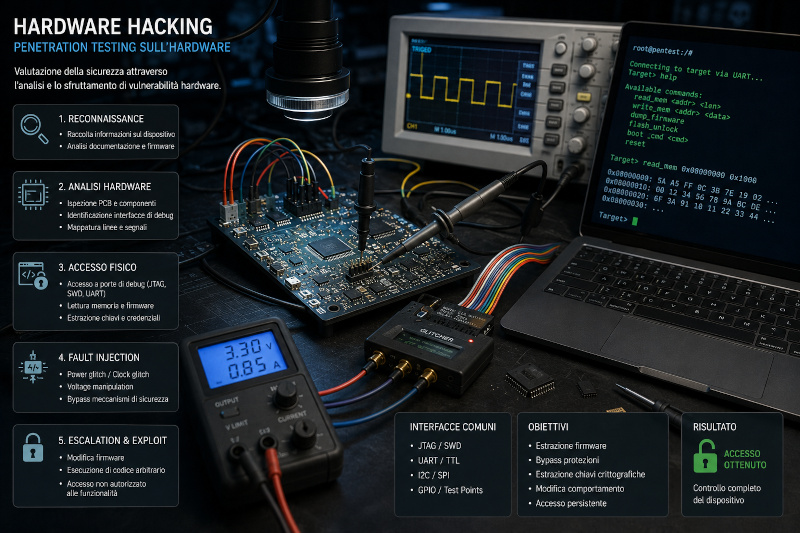
Physical and logical security assessment on hardware and firmware. Real analysis, concrete findings.
Most embedded security assessments stop at the software layer. Hard Probe Cybersec starts from the hardware: physical attack surfaces, firmware extraction and reverse engineering, hardware interface exploitation, and logical vulnerability analysis — treated as a single attack surface, not separate checklists.
What we assess
- Penetration testing, incremental effort steps, black box and white box.
- Firmware extraction via JTAG, SWD, UART, SPI flash, component removal and other interfaces
- Bootloader security: secure boot implementation, bypass vectors, update chain integrity
- Firmware reverse engineering: binary analysis, hardcoded credentials, cryptographic misuse
- Hardware attack surfaces: debug port exposure, glitching susceptibility, side-channel leakage
- Communication protocol security, wired and wireless: authentication, integrity, replay and injection
- CRA compliance support: security assessment aligned with EU Cyber Resilience Act requirements
How we work
The engagement starts with a threat model scoped to the actual product and its attack surface, not a generic framework applied by default. Assessment is hands-on: physical access to the device, instrumentation on the hardware interfaces, analysis tools applied to the actual firmware binary.
Findings are documented with exploitation evidence, impact assessment, and concrete remediation guidance. No vague risk scores, no findings that require a security consultant to interpret.
Who this is for
Product companies preparing for CRA compliance or pre-market security validation. R&D teams that need to know what an attacker with physical access can actually do to their device. Organizations that have received a theoretical audit and want to know what it missed.